How a Maple Zen Bed Is Actually Built: Joinery, Upholstery, and What Makes a Frame Last
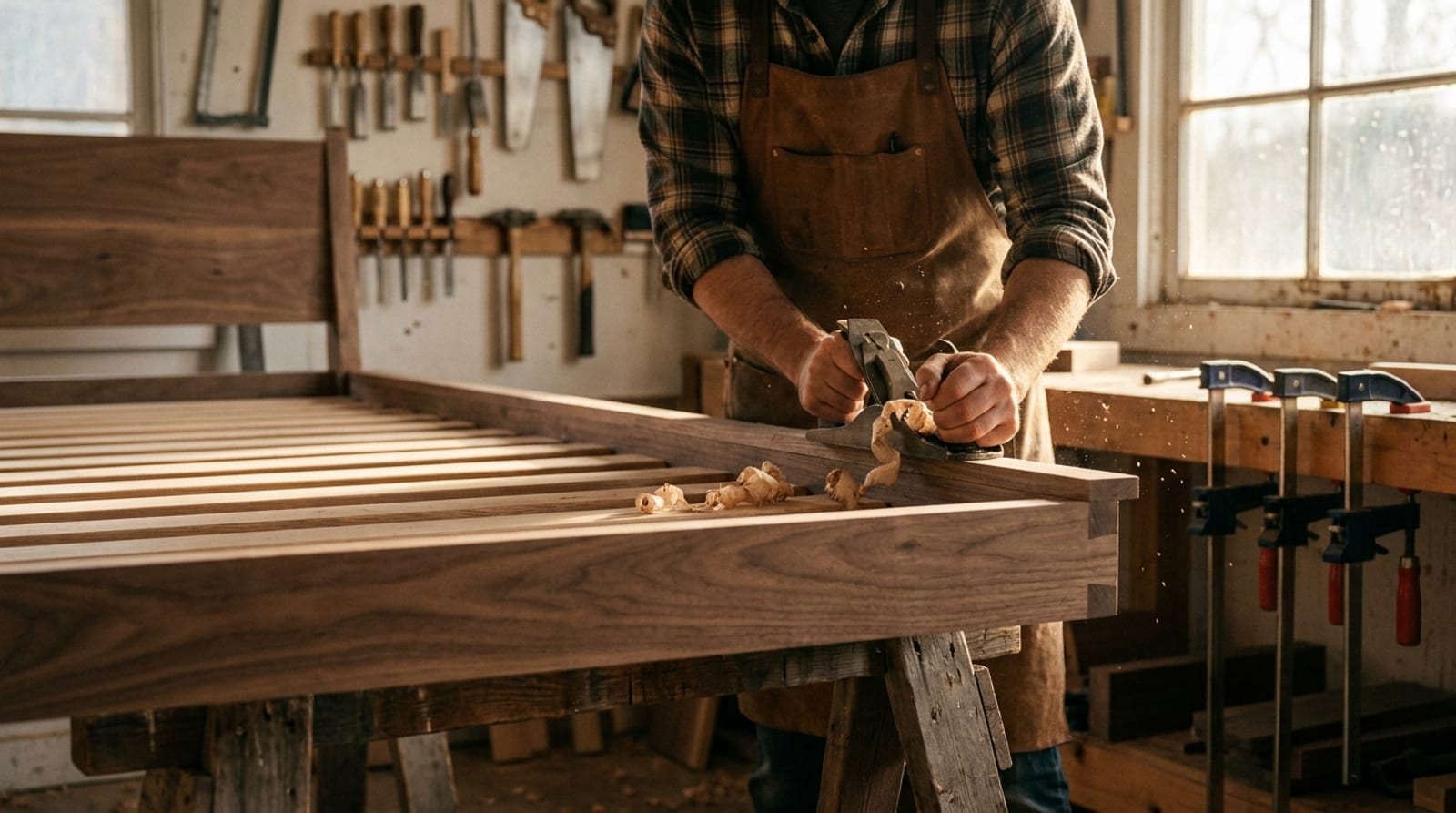
A bed frame is the most invisible piece of furniture you own. Once the mattress goes on and the duvet goes over, you may not look at it squarely again for years — but you will feel it every single night. A well-built frame disappears in the best way: no creak when you turn over, no slow lean toward one corner, no mysterious wobble that shows up in year two. A poorly built one announces itself a little more each month. Since our craftsmen have been building fine furniture since 1988, we thought we would pull back the curtain and walk through what actually goes into a bed that lasts — and what to look for no matter whose bed you buy.
It starts with the wood
Every frame begins as lumber, and the decisions made at the lumber stage echo for decades. Wood that has not been properly dried keeps moving after it is built — shrinking in winter's dry furnace heat, swelling in a humid Toronto July — and that movement is where squeaks and loose joints are born. Properly dried, well-selected hardwood, cut with the grain in mind, stays where the builder put it. This is also where "designed for life" begins for us: choosing high-quality, sustainably sourced materials is slower and costs more than grabbing whatever is on the pallet, but it is the difference between a frame that settles in and one that falls apart.
Joinery: where a frame lives or dies
If you remember one thing from this post, make it this: a bed frame is only as good as its corners. The corners carry the load, take the sideways stress every time you sit down on the edge, and absorb years of being nudged, moved, and leaned on.
Mass-market frames are often stapled, glued at thin edges, or held by small screws driven straight into particleboard — connections that loosen a little with every season. A frame built to last uses real joinery: interlocking cuts that mate wood to wood, and proper bolted connections that can be snugged tight again in a minute if they ever need it. When our craftsmen fit a corner, the joint holds square on its own before any hardware touches it. The hardware is insurance; the joinery is the structure.
The platform is part of the mattress
A bed's platform has one quiet, essential job: to support your mattress evenly across its whole surface, so the foam or springs wear the way the mattress maker intended — sag in the platform becomes sag in the mattress, and then in your back. The Zazen Bed uses a solid platform base, secured so it cannot shift or chatter, with no gaps for a mattress to dip into. It also means you do not need a box spring. It is one of those details nobody sees and everybody feels.
Upholstery, the slow way
The upholstered frame is where a Zazen Bed gets its character, and it is the most hands-on stage of the build. Padding is layered and pulled taut so the surface stays smooth for years instead of puckering. Our premium vegan leather is cut generously, wrapped around edges rather than stopping at them, and fastened where fasteners belong: out of sight and out of contact.
Then comes the tufting — the stitching and buttoning that gives a headboard its pattern. Whether you choose box tufting, diamond tufting, or one of our channel styles, each pull is set by hand, one at a time, so the tension is even across the whole headboard. It is slow work. It is also why a hand-tufted headboard still looks crisp when a machine-pressed pattern has gone soft and shapeless.
What to ask before you buy any bed
You do not need to be a woodworker to shop like one. A few questions separate the lasting frames from the landfill-bound, whoever the maker is:
- What is the frame actually made of? "Wood" can mean solid hardwood or glued sawdust. Ask.
- How are the corners joined? Listen for real joinery and bolts — not staples and glue.
- What supports the mattress? A solid, well-secured platform beats a thin deck or a sparse wire grid.
- Can it be tightened and repaired? A frame built with proper connections can be maintained for decades; a stapled one cannot.
- Who built it, and where? A maker who will tell you exactly who built your bed is a maker who stands behind it.
Every Zazen Bed is handcrafted in our workshop in Maple, Ontario by craftsmen with decades of experience, built with exacting attention to detail, and made to order in your choice of size, colour, headboard height, and tufting style. It is designed for life — both to handle everything life brings, and to last for years to come. If you would like to see what that care feels like to sleep on, we would love to build one for you.